GlucoSense: Non-Invasive Glucose Monitoring using Mobile Devices

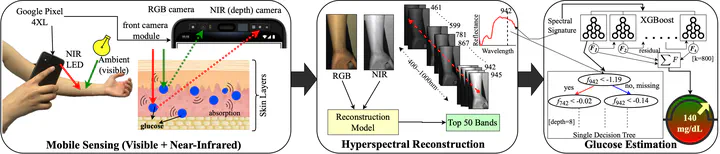 GlucoSense
Abstract
Regular glucose monitoring is crucial for diabetic patients to avoid the risk of health complications such as stroke, kidney
failure, heart disease, and even death. Most current devices
for measuring glucose are costly and painful. We propose
GlucoSense, a non-invasive glucose sensing solution on mo-
bile devices. GlucoSense builds on the fact that glucose is an
optically active molecule, which interacts with various wave-
lengths. We first conduct spectral analysis to demonstrate
the feasibility of measuring glucose in the visible and near-
infrared range (400–1000 nm), which is the range available
on mobile devices. We also identify the relative importance
of various spectral bands in this range. We further propose
multiple practical designs for obtaining the required spectral
bands for measuring glucose. We then design GlucoSense
exploiting the sensing capabilities of modern smartphones
combined with machine learning models. We conduct an
ethics-approved user study with a diverse set of participants
in terms of age, sex, ethnicity, and body mass index (BMI). We
compare GlucoSense against a widely-used, FDA-approved
glucose measuring device. Our results show that 80.4% of Glu-
coSense predictions are within Zone A (clinically accurate),
and the remaining 19.3% are in Zone B (clinically accept-
able) of the Clarke Error Grid (CEG). In addition, 99.7% of
the predictions are within the None and Slight risk zones
of the Surveillance Error Grid (SEG), indicating their high
accuracy. Both CEG and SEG are standard metrics for assess-
ing glucose-measuring devices. These results were obtained
by GlucoSense running on unmodified phones in realistic
environments with diverse illuminations.
Type
Publication
In The 31st Annual International Conference on Mobile Computing and Networking